ProofFix — built with IBM Bob

prove → fix → verify → coach

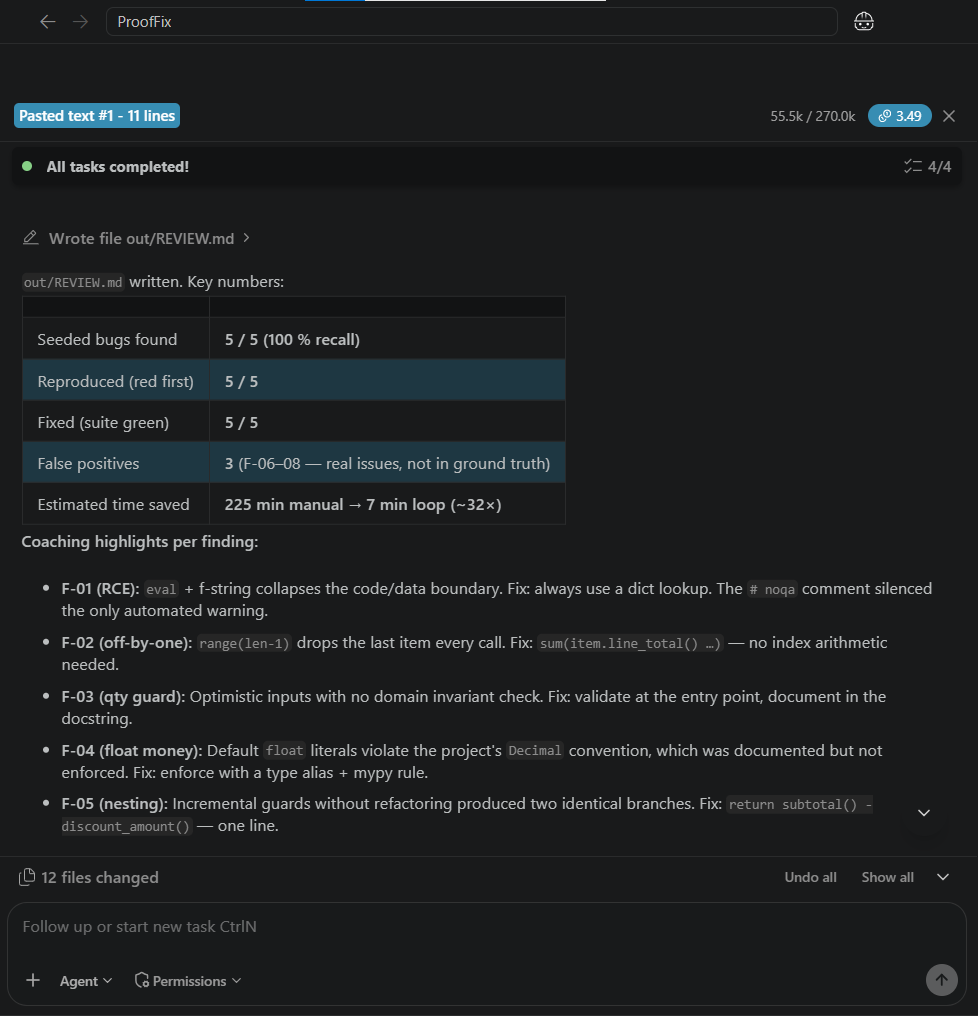
7 min

is what it took to review, prove, fix, and verify five planted bugs in a small Python module — a task that would take an experienced developer roughly 3 hours 45 minutes by hand.

Manual 225 min
ProofFix 7 min

~32× faster on this run, across five bug classes: a remote-code-execution risk, an off-by-one total, an unvalidated quantity, float-based money math, and duplicated logic.

Why this is different

Most AI review tools stop at suggesting a fix. ProofFix treats a suggestion as a claim that has to be checked.

1

Prove

Write a test that fails, so the bug is demonstrated — not asserted.

2

Fix

Apply the smallest patch, then run the full suite to confirm nothing else broke.

3

Coach

Explain why it happened and how to avoid the same mistake next time.

Run live in IBM Bob

Each stage below ran as its own IBM Bob mode, with access limited to what that job needed — read-only for review, edit-and-run for fixes, markdown-only for the report.

Agent
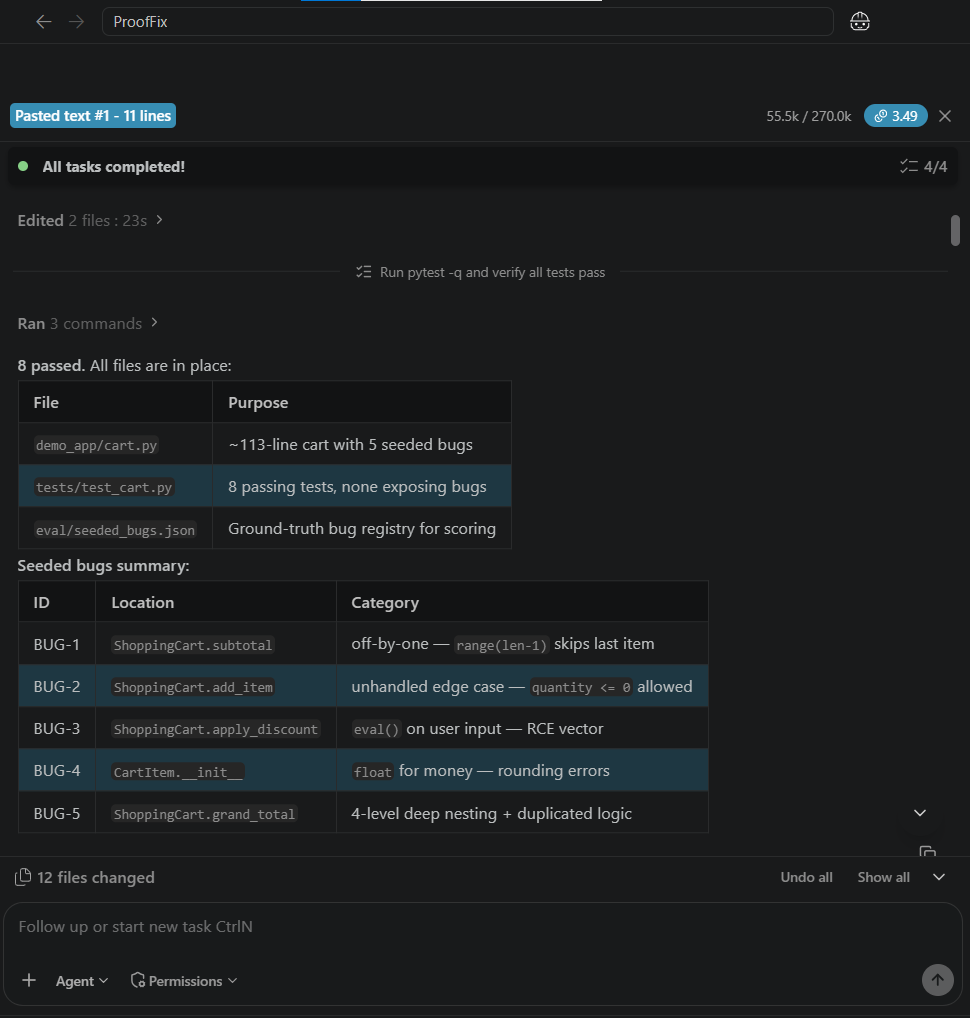
Bob Agent mode session completing the scaffold phase
Phase 0 · Scaffold. Agent mode builds the demo app, its passing tests, and the seeded-bug ground truth.
Reviewer
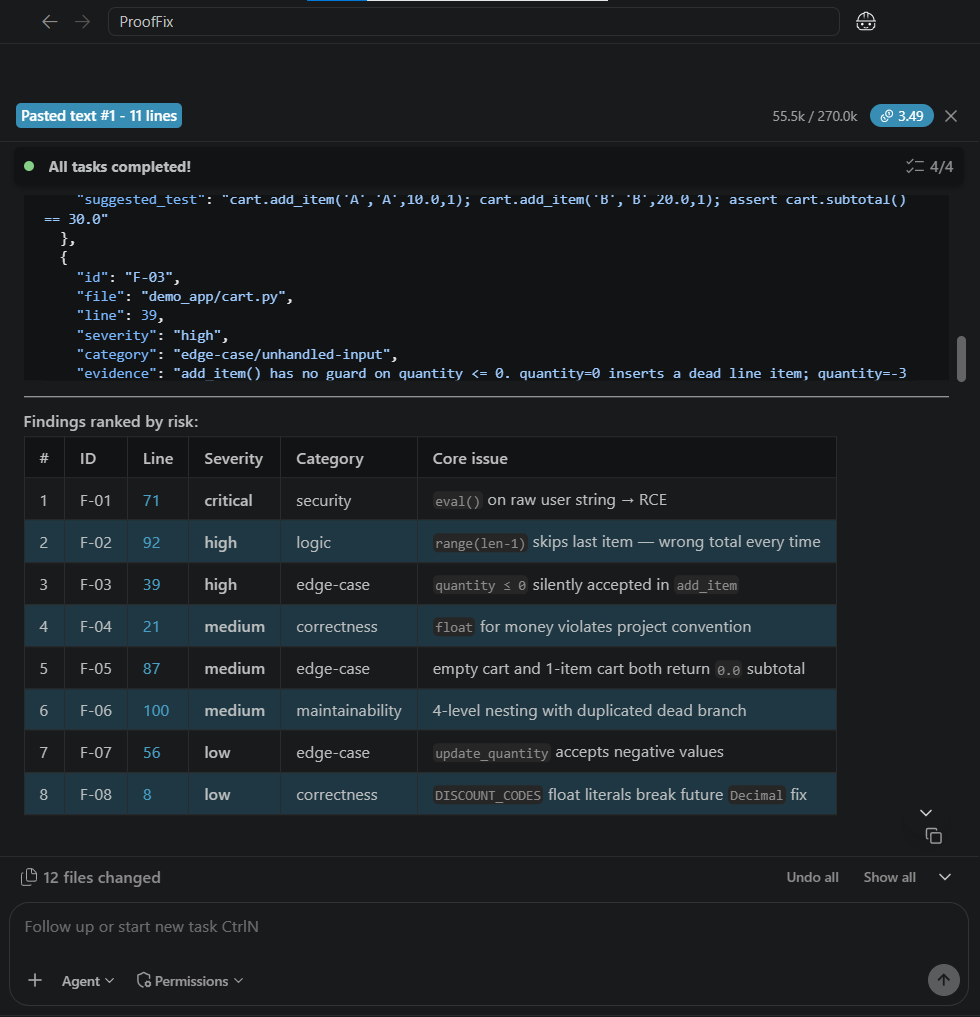
Bob Reviewer mode session listing ranked findings
Phase 1 · Review. Reviewer mode, read-only, ranks findings by risk with file/line evidence.
Debugger
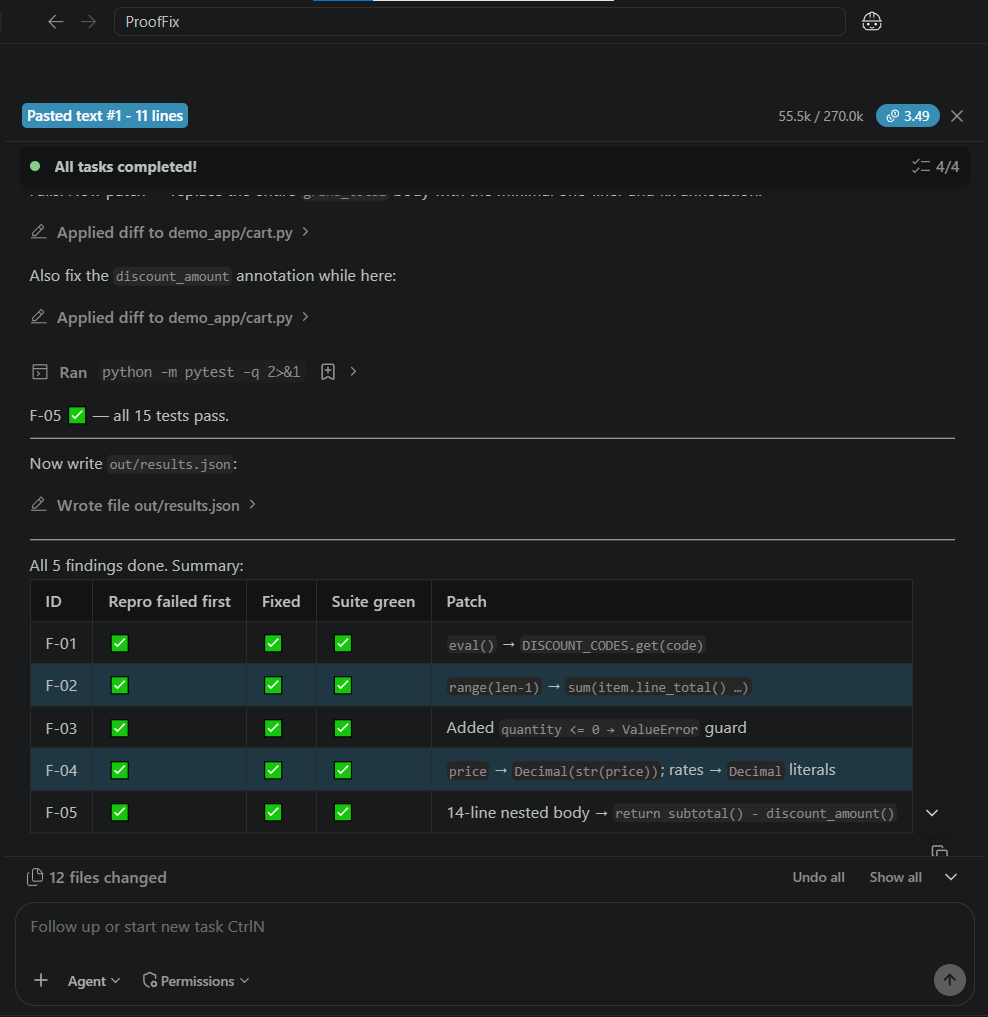
Bob Debugger mode session showing a failing test turn green after a fix
Phase 2 · Repro & fix. Debugger mode writes a failing test per finding, patches it, then reruns the full suite.
Coach
Bob Coach mode session writing the review report
Phase 3 · Coach. Coach mode, limited to Markdown edits, writes the scored report you see below.

What it found

Five bugs were deliberately planted in a small shopping-cart module. Click a finding to see the proof, the fix, and the lesson.

F-01 Discount codes evaluated with eval() critical 28×
Risk
A crafted discount-code string could execute arbitrary code inside the server process.
Proof
An injected payload triggered evaluation before the fix — confirmed with a failing test.
Fix
Replaced eval() with a plain dictionary lookup.
Lesson
Never pass user-supplied strings into eval or exec; use a lookup table instead.
F-02 Off-by-one error drops the last item from every total high 40×
Risk
Every multi-item cart under-charged by the price of its last item; single-item carts totalled zero.
Proof
A two-item cart returned the wrong subtotal before the fix.
Fix
Replaced manual index arithmetic with a plain sum over all items.
Lesson
Prefer iterating a collection directly over hand-written index ranges.
F-03 Zero and negative quantities silently accepted high 40×
Risk
A quantity of zero or less could insert ghost items or push stock counts negative.
Proof
Adding an item with quantity 0 completed without error before the fix.
Fix
Added a validation guard that raises on non-positive quantities.
Lesson
Validate domain rules at the point of entry, not downstream.
F-04 Money stored and summed as float medium 30×
Risk
Floating-point rounding drift accumulates across line items, producing penny-level errors.
Proof
Ten items at $0.10 summed to a value slightly off $1.00 before the fix.
Fix
Switched prices and rates to Decimal throughout.
Lesson
Never use float for currency; use a fixed-point type from the start.
F-05 Duplicated branches in the total calculation medium 30×
Risk
Two identical branches meant a future change to the discount formula could be made in one place and missed in the other.
Proof
A type-hint check confirmed the method hadn't been reconciled with the rest of the codebase.
Fix
Collapsed the duplicated branches into a single, direct calculation.
Lesson
When two branches are identical, extract the shared logic instead of guarding around it.

The same run also surfaced three additional real issues beyond these five — a related empty-cart edge case, an unguarded negative-quantity update, and a float/Decimal mismatch in the discount table.

Result

5/5
seeded bugs found
5/5
reproduced with a failing test
5/5
fixed, full suite green
15
tests passing

Built with three IBM Bob modes

Each mode has exactly the access its job needs — nothing more.

ModeRoleAccess
Reviewer Finds and ranks issues by risk Read only
Debugger Writes the failing test, applies the fix, runs the suite Read, edit, run commands
Coach Writes the report and scores the run Edit limited to Markdown files